
When we think of seagrass, we often imagine vast underwater meadows, gently swaying in crystal clear water. But what about seagrass in estuaries and intertidal areas like mudflats? This blog explores how the MGET team is trying to understand if the Mersey estuary could support seagrass in the future and what benefits that would bring to the area.
Seagrass are flowering plants that grow in sediment that is entirely or regularly submerged in water. Unlike its name would suggest, seagrass is not actually a grass, it is closer related to lillies and ginger than to grass. A very interesting fact about seagrass is that pollination takes place entirely under water – the only plant in the world that is able to do that.
There are 60 species of seagrass recognised, four of which are known to be present in the UK. The species we want to focus on is Zostera noltii, also called Dwarf Eelgrass. Dwarf Eelgrass is a species that is adapted to intertidal areas, meaning it can live in tidal areas where the plant is exposed on the mudflats during the ebb of the tide. The closest record of this plant is along the Welsh coast, around Anglesey, but is also present in estuaries such as Morecombe Bay.

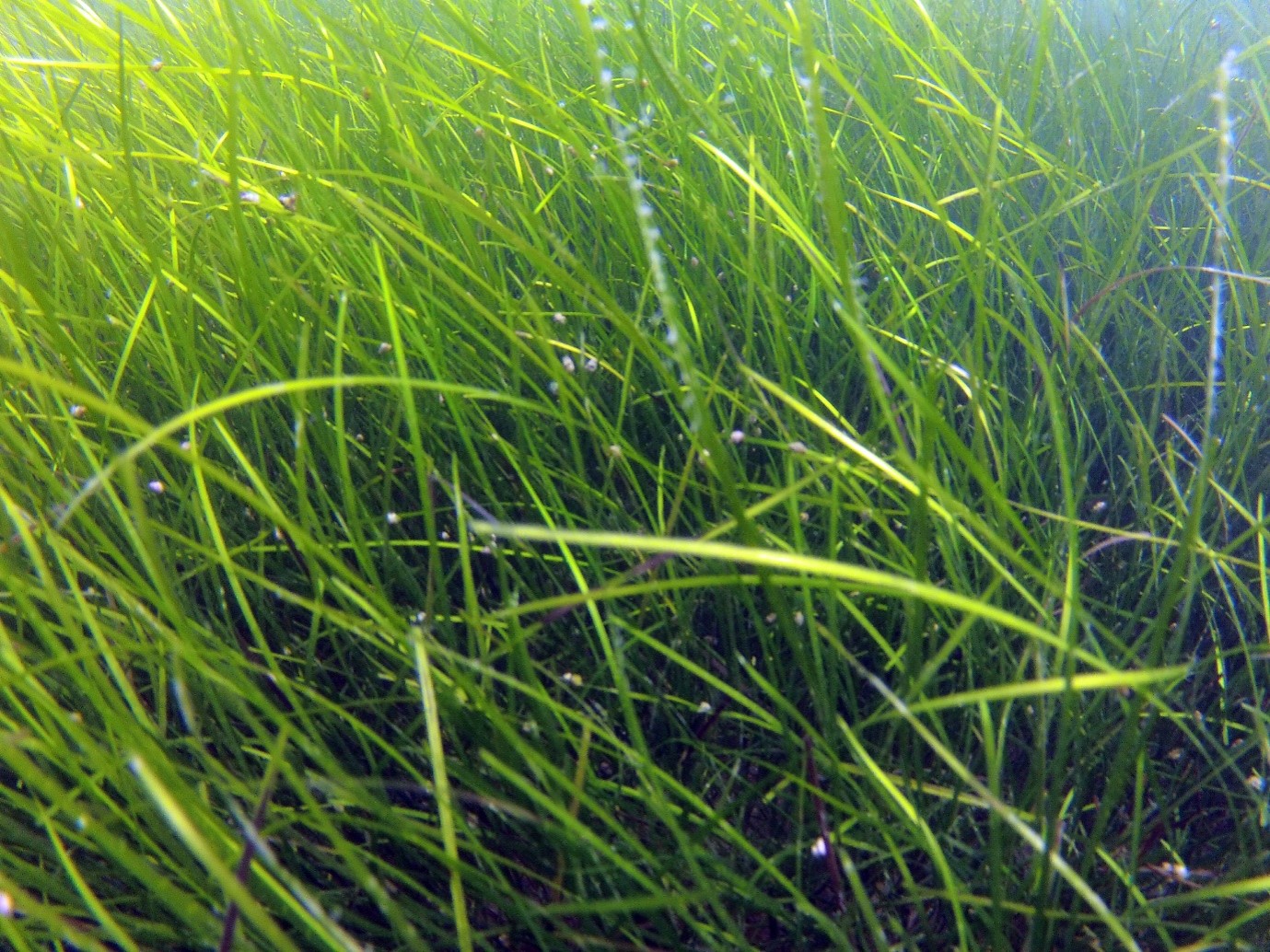
Submerged Zostera noltii
By Dimitar Nikolov Berov - Provided by Dimitar Nikolov Berov to EU funded project RECONNECT Balkan-Mediterranean 2014-2020, to be published on Wikispecies., CC BY-SA 4.0, https://commons.wikimedia.org/w/index.php?curid=91428433

Zostera noltii on muddy sand
https://www.marlin.ac.uk/habitat/detail/318
Seagrass role and benefits
Like many habitat types, seagrass meadows have undergone a huge decline over the last century or more, including Dwarf Eelgrass. It is classed as scarce in Great Britain and has a national Red listed status of Vulnerable. Globally, the species is not threatened because it is still common in other areas around the world, such as Europe and North Africa.
The plant is fairly sensitive to pollution of the sediment, so following the industrial revolution and urbanisation of our coastlines, seagrasses had a hard time surviving. Records have always been a bit patchy, possibly not because seagrass wasn’t present, just simply because no one recorded it.
However, seagrass has a very important role in the ecosystem. Some of its benefits are that it stabilises sediment; it can act as a nutrient filter, removing access nutrients like nitrogen and phosphate from the water; it offers shelter for fish and aquatic invertebrates and it captures carbon. With this wide range of benefits, it has to be a great candidate for any estuarine nature conservation project and deserves some attention.
Seagrass in the Mersey
In 2021, Natural England published a high-level study looking at potential sites where seagrass could be successful, which included sections of the Mersey estuary. This got us thinking – could we develop a project that looks into the feasibility of having seagrass present in the Mersey? And if yes, how could that look like? What have other organisations around the UK done and what methods could work for the Mersey? Many questions, no simple answers – as usual!

Collecting Mersey sediment.
Based on the initial study by Natural England, we asked Sara Clark, a MRes student from the University of Salford, if she could develop a more specific analysis for the Mersey. She produced a habitat feasibility study as part of her degree, which showed more specific areas in the Mersey estuary, where an introduction of Dwarf Eelgrass could be successful by looking much closer at what parameters it needs, what the sediment in the Mersey is like and if it could support the establishment of seagrass on our local patch. The results were promising and encouraged us to continue working on this.
We started to design a trial site away from the estuary itself (an ex-situ system) to see if seagrass can survive and maybe even thrive under Mersey conditions. We were lucky enough to be successful to receive some funding from the Environment Agency for this. To grow seagrass in a nursery setting is not uncommon, and there are several places around the UK that do that, but this will be the first one testing how seagrass grows under local conditions in the North West.
The system has been set up at the University of Salford, and we will be able to replicate conditions such as quality of sediments, salinity, tidal and light conditions to a certain extent, while at the same time, having controlled and regular access to check on the plants. So far, the system has not yet received any plants yet, but we are excited to plan our trip to Anglesey in the next few weeks, where the University of Bangor will help us to transfer some of the Welsh seagrass to our system in Salford (with permission from Anglesey Council and Natural Resources Wales).
In the next few months, we will learn some incredible things about seagrass and the potential for nature conservation in the Mersey. Join us on our seagrass journey!
